Friday, March 19, 2010

Hubble Ultra Deep Field 3D


This is a pretty incredible four minute video. It starts off a bit slowly, but sticking with it is worth it. It's the final minute that is the best.

Wednesday, January 6, 2010

Life in the Universe


There is definitely life in the universe. It is us! Is there other life in the universe, though? And if so, are "they" like "us"? The Drake Equation allows us to consider some of the variables that would influence the development of advanced, technological, intelligent life around the galaxy. Some others, including Dr. Michio Kaku of City University of New York, have speculated about the nature of advanced life based on the idea that the laws of physics are universal, and they place limits on the development of life. Some of his speculation focuses on the need for advanced civilizations to harness vast amounts of energy just to avoid being wiped out by natural disasters. And of course the biggest natural disaster of them all is the end of the universe- current theories suggest that the universe has an open structure, which means that the ultimate fate of the universe is ever accelerating expansion and cooling, a "Big Chill". If civilizations become advanced enough, they may be more interested in escaping this universe by manipulating space and time itself rather than contacting their neighbors...
But enough about physics. From what we k now about the evolution of advanced civilization on earth, which of the following statements would you think is most likely to be as universal as gravity itself? Write your answer as a blog comment below.
· Life will inevitably emerge when conditions are suitable

· When life emerges, it will lead to advanced intelligent civilizations

· When life emerges, it will be based on cells

· When life emerges, it will be subject to natural selection

For more information about Dr. Kaku visit http://www.astrobio.net/news/modules.php?op=modload&name=News&file=article&sid=939&mode=thread&order=0&thold=0

Thursday, November 12, 2009

New Clue to Extrasolar Planetary Systems- Lithium!

Astronomers have known for some time that sunlike stars with high iron content are more likely to harbor planetary systems than other stars. Now they have a new clue- the amount of lithium. As we know from class, using spectroscopy we can determine the composition of faraway stars. So now we know that if a star has high iron and low lithium it is very likely to have planets. But why low lithium?
Garek Israelian, with the Instituto de Astrofisica de Canarias in Spain have analysed data from 133 sunlike stars. The leading explanation is that having planets around a newly forming star slows the rotation- and allows the lithium to sink lower into the core of the star where it can be consumed by fusion as part of the star's energy source. Without the drag of the planets, the star spins faster and the lithium stays near the surface, where temperatures are too low for lithium fusion to occur.
This is only true of sunlike stars near the middle of the main sequence on the H-R diagram. Small red stars always burn up their lithium quickly regardless of whether there are planets or not; large blue stars experience layering that prevents the mixing of the elements.

Tuesday, October 20, 2009

Even more planets discovered via "wobble" method

An international group of astronomers using the High Accuracy Radial Velocity Planet Searcher (HARPS) have announced the discovery of 32 new planets, with many more announcements on the way. They had already announced the discovery of 43 other planets, bringing the total so far to 75. This is the result of a five year program of the European Southern Observatory that used a telescope in Chile.
Among the 75 planets discovered are 24 so-called super-Earths; planets with a mass just a few times that of Earth (not gas giants.) Only 28 super-Earths in total have been discovered by researchers around the world. This radial velocity method which looks for wobble is very good at finding these smaller planets.
The following link will show you an animation that demonstrates how the Radial Velocity Method works.
http://commons.wikimedia.org/wiki/File:Planet_reflex_sm.gif


Wednesday, October 7, 2009

Probe to crash into the moon on Parents Day!


A final location has been decided for the two-part lunar crash probe, part of the mission known as LCROSS (Lunar CRater Observation and Sensing Satellite), "On 9 October, at around 11:30 GMT, LCROSS will send its Atlas V's Centaur rocket upper stage towards the lunar surface (see pic). Four minutes after impact, LCROSS will descend through the plume using two "two near-infrared spectrometers, a visible light spectrometer, two mid-infrared cameras, two near-infrared cameras, a visible camera and a visible radiometer" to sniff the resulting chemical mix." (http://www.theregister.co.uk/2009/09/29/lcross_retargeted/ )
The LCROSS probe itself will then crash into the moon. The hope is that it will find evidence of water.
Well it all went as planned, and information about the event from NASA can be found at http://www.nasa.gov/mission_pages/LCROSS/main/index.html
A great video simulation can be found at http://www.nasa.gov/mov/391565main_LCROSS-MediaPreview.mov


A new, giant, massive ring has been discovered around Saturn- so large that a BILLION earths could fit in it! It is more than 300 Saturns wide! How could astronomers have missed it?

Well, it turns out the ring is almost invisible, that's how. While it is about 40 million kilometers across it is exceedingly thin. It is made of dust-like ice and rock particles that barely reflect any of the feeble sunlight that reaches Saturn- but the sun does heat them up. So it was the Spitzer infrared telescope that finally noticed the giant ring.


Wednesday, September 16, 2009

Remember the Rovers?


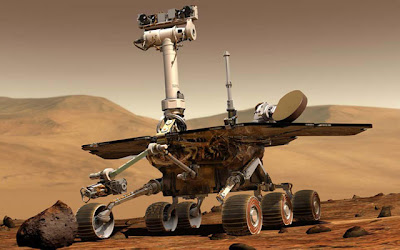
The Mars Rovers are the robots that were sent to Mars when today's juniors and seniors in high school were still in middle school. They had a three month mission. They've been at it about five years. In fact, just a month ago the rover Spirit celebrated its 2000th "sol", or Martian day. It's been experiencing some rough weather recently- dust storms.
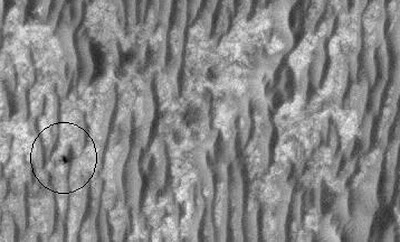
Thr rover Opportunity, on the other hand, has been plodding away. In fact, in the photo below, you can see a photo of Opportunity taken by an orbiting satellite. If you look carefully, you can even see the wheel tracks it has left behind. Opportunity has travelled over 100 meters in a day. It is headed toward an interesting crater named Endeavor. At this rate, it will be thee in about two Earth years.

Credit: NASA/JPL/University of Arizona

Wednesday, September 9, 2009

New lease on life for Hubble


If you are a regular follower of this blog, then you know that last October it carried a story about the Hubble Space telescope upgrade being cancelled. (See http://sms-astro-08.blogspot.com/2008/10/hubble-time-to-say-goodbye.html)
Then of course the astronomy class is not offered again in the spring, so the blog hibernates. Well, last spring the Hubble was in fact rejuvenated- last May, shuttle astronauts did a series of repairs and upgrades and two new instruments were added. The official NASA press release can be found here.
It took three months of calibrations to get the telescope back on line, but today NASA released some of the images taken by the refurbished Hubble. Plans are to observe "Kuiper Belt objects at the fringe of our solar system; survey the birth of planets around other stars; and probe the composition and structure of extrasolar planet atmospheres; take the deepest-ever near-infrared portrait of the universe to reveal never-before-seen infant galaxies that existed when the universe was less than 500 million years old;and shed light on the behavior of dark energy, a repulsive force that is pushing the universe apart at an ever-faster rate."
The picture at the top of this blog gives some idea of the amount of detail the images contain; the image below is of colored stars in a cluster actually zoomable on the Hubble site itself.


Wednesday, September 2, 2009

Beautiful Astronomy


In class we were discussing telescopes, and how they can show us things our eyes can't see because they collect more light by having bigger "pupils" (apertures.) Another way to collect more light is to spend more TIME collecting the light- this is what cameras do. Dr. Belknap, who is now in Jordan, alerted me to the first annual Astronomy Photographer of the Year contest, sponsored by England's Royal Observatory. Two British newspapers have posted some of the entries on their web sites- the Telegraph and the Guardian.
These are worth looking at- hard to pick a favorite, but the image above is quite nice. It is from the Telegraph site, and is described as


This colourful nebula, known as the Gabriela Mistral Nebula, contains a mass of giant, hot young stars. The bright colours are caused by different chemical elements found in the nebula as energy released from the stars excites the atoms and causes them to glow with different colours of light. It is named after the Chilean poet Gabriela Mistral as it is thought to bear a striking resemblance to her in profile.By Steve Crouch


Wednesday, August 26, 2009

The Myth of Mars


http://www.lcsd.gov.hk/CE/Museum/Space/StarShine/AstroEvent/MarsAtOpposition/e_starshine_ae_mao.htm
It seems that every summer since 2003 there is an exciting announcement that "Mars will be as large as the FULL MOON!" and "No living human has ever seen this before or will ever see it again!"
This summer the story says that Thursday, August 27 is that day- the first day of Astronomy class! How exciting! Unfortunately, it's just not true and everyone from Snopes to NASA can explain why.
So let me join in on debunking this story.
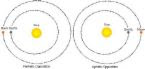
Planets orbit the sun not in circles but ellipses (off-centered ovals) and they orbit at different speeds. So as they orbit, the planets "pass" each other regularly, and they are both on the same side of the sun. And the distance between them varies, depending upon what part of the oval they are on. So while it is true that in 2003 (August 27, actually) the Earth and Mars were closer than they had been in 60,000 years, they weren't that much closer than they get every 15 years or so- and every two years they are "closer than usual". This is called perihelic opposition, and the closest the two planets can get to each other is 35 million miles, but it might be as much as around 60 million miles.

So while Mars can get within about 35 million miles of the earth every couple of decades, and it can get quite bright, it will never look as large as a full moon. It's just too far away.

Tuesday, August 25, 2009

First Homework Assignment!

Homework 8-27-08 DUE BY MONDAY AUGUST 31 2009
Read the introduction to your textbook, pages 2-11.
Choose ONE of the following questions and answer it thoroughly. This is your first homework, and with it you are making a first impression upon your teacher. Use your best written English to answer the question. Demonstrate your ability to communicate. Your grade will be based on your quality of expression; there is no “right” or “wrong” answer. Show me the best writing of which you are capable.YOUR RESPONSE SHOULD BE ADDED AS A COMMENT TO THIS BLOG.
1. It has been suggested that the universe may be 15 billion years old. The introduction of your textbook defines a light year as the distance traveled by light on one year. Light travels at about 3 x 10^5 kilometers (km) per second. Explain how this information could be used to predict that the universe must be smaller than 2 x 10^26 km across.
2. The Bible states in Joshua 10:12-13 that “…the sun stood still and the moon stopped, till the nation avenged itself on its enemies, as it is written in the book of Jashar. The sun stopped in the middle of the sky and delayed going down about a full day.” (Scripture taken from the Holy Bible, New International Version, 1984, International Bible Society, Colorado Springs, CO. Used by permission.) Is there any conflict between believing the biblical account of the sun stopping in the sky and the structure of our solar system as described in the introduction of your textbook?
3. One reason that many people are interested in astronomy is the possibility that life exists beyond the earth. With particular reference to the description of the scientific method, what sort of evidence (not including actually meeting an alien!) do you feel would be required to make a strong claim that life probably exists elsewhere?

Tuesday, December 9, 2008

Life in the Universe

There is definitely life in the universe.  It is us!  Is there other life in the universe, though? And if so, are "they" like "us"?  The Drake Equation allows us to consider some of the variables that would influence the development of advanced, technological, intelligent life around the galaxy.  Some others, including Dr. Michio Kaku of City University of New York, have speculated about the nature of advanced life based on the idea that the laws of physics are universal, and they place limits on the development of life. Some of his speculation focuses on the need for advanced civilizations to harness vast amounts of energy just to avoid being wiped out by natural disasters. And of course the biggest natural disaster of them all is the end of the universe- current theories suggest that the universe has an open structure, which means that the ultimate fate of the universe is ever accelerating expansion and cooling, a "Big Chill". If civilizations become advanced enough, they  may be more interested in escaping this universe by manipulating space and time itself rather than contacting their neighbors...
But enough about physics.  From what we k now about the evolution of advanced civilization on earth, which of the following statements would you think is most likely to be as universal as gravity itself?  Write your answer as a blog comment below, before the end of the day December 19 2008.
·         Life will inevitably emerge when conditions are suitable

·         When life emerges, it will lead to advanced intelligent civilizations

·         When life emerges, it will be based on cells

·         When life emerges, it will be subject to natural selection

For more information about Dr. Kaku visit http://www.astrobio.net/news/modules.php?op=modload&name=News&file=article&sid=939&mode=thread&order=0&thold=0 

Friday, November 21, 2008

The International Space Station- the tenth anniversary numbers


Nov. 20, 2008- today
Nov. 20, 1998- Russians launch the first component of the International Space Station from their space center in Kazakhstan.
16- number of nations supporting the space station (including NASA, the Russian Federal Space Agency, Canadian Space Agency, Japan Aerospace Exploration Agency, or JAXA, and 11 members of the European Space Agency, or ESA: Belgium, Denmark, France, Germany, Italy, the Netherlands, Norway, Spain, Sweden, Switzerland and the United Kingdom.)
14- number of countries that have sent crews to the space station
167- number of individuals who have crewed the station
19,000 – number of meals they have eaten in space
30- number of flights to the station by American and Russian spacecraft
114- number of spacewalks involved in the construction of the station
1 - The length of the space station in football fields
6- area of the solar energy panels in basketball courts
240- number of miles above the Earth the space station orbits
57,309- number of orbits the station made in ten years
1,432,725,000- number of miles the station has travelled (That’s about a billion and a half miles- about the distance to Uranus!)
100,000- number of people on earth involved in support for the space station
http://www.nasa.gov/mission_pages/station/main/10th_main.html

Monday, November 17, 2008

Phoenix Obituary


The Mars lander Phoenix has apparently stopped functioning after five months of data collection. It was the northernmost landing area of any spacecraft sent to Mars. "Apparently", because the mission engineers will continue to monitor for signals sent by Phoenix, but it is likely that the recent dust storms on Mars have not allowed enough sunlight to reach its solar panels to allow the equipment to continue operation. The lander was originally intended to function for three months. The last signal was received November 2, 2008.

It was a very sophisticated remote laboratory, and among its accomplishments were confirming the presence of water-ice below the surface of Mars (it had an arm for digging into the soil), taking over 25 000 photos using the first "atomic force microscope" ever used outside the Earth, doingn chemical analysis of the martian soil, and studying martian weather, including the first ever observation of snow falling from the clouds on Mars! (See this blog September 29). All things Phoenix can be found at http://www.nasa.gov/phoenix .


Monday, October 20, 2008

Accelerating Returns

In August, Richard Dell and Alan Rich from the Google Lunar X-Prize team STELLAR came to our school to talk about their proposal for lunar exploration. In the course of the discussion, some students questioned whether or not the progress Mr. Dell and Mr. Rich were talking about could possibly occur so quickly. Mr. Dell argued that we can expect that rate of progress, and referred to Kurzweil’s law. It might be worth looking into what that “Law” really is.
In a nutshell, it proposes exponential growth in technological progress. But a nutshell doesn’t really do it justice, so we must step back a bit first. Have you heard of Moore’s Law? This states that the capabilities of digital electronic devices will increase exponentially, doubling every two years. Capabilities include such factors as computer processing speed, but also things that are found in consumer electronics such as memory storage capacity, or pixels in a digital camera. Moore’s law was formulated and stated in a paper by Intel co-founder in 1965. It has pretty much been true for electronic hardware. (an argument has been made that software complexity slows things down faster than hardware speeds things up, but that’s another blog entry…)
Ray Kurzweil takes this idea one step farther, and extrapolates to before the invention of the integrated circuit, and beyond to technologies that haven’t yet been invented. He argues that the rate of change is accelerating; that the technological progress during the 20th century (think: Henry Ford and the Wright brothers to Bill Gates and the Space Shuttle) will be exceeded by a factor of a THOUSAND in the 21st century. It even suggests a “technological singularity”, technological progress hastened beyond anything ever seen as a result of machines smarter than humans learning to improve their own designs…
This is not to say that everyone accepts Kurzweil’s Law, there are plenty of criticisms and you can find them in some of the web sites referenced below. Thanks to Richard Dell for helping with the research for this posting.
http://en.wikipedia.org/wiki/Technological_Singularity
http://en.wikipedia.org/wiki/Moore%27s_Law
http://en.wikipedia.org/wiki/Raymond_Kurzweil#The_Law_of_Accelerating_Returns
http://en.wikipedia.org/wiki/Accelerating_change
http://www.kurzweilai.net/meme/frame.html?main=/articles/art0610.html?m%3D1

Thursday, October 16, 2008

No Sunspots- a 50 year low!

In class we discussed sunspot and other solar activities. I set up the refractor telescope after class in order to image the sun so that you could see some sunspots; but there appeared to be nothing there!  Nothing.  I thought that was very strange, so I did some research.  Guess what?  Just this month NASA's Marshall Space Flight Center announced that we are in the midst of a deep minimum of the solar cycle the likes of which have not been seen since BEFORE the launch of Sputnik (see earlier blogs), even before Mr. Mueller was born!  You have to go back to 1954 to find a year with a quieter sun. If the trend continues, it could end up being the quietest year for solar activity in a century.  Having said that, they believe that the 20th century was a particularly active time for solar activity, and that this may be more of a normal level of sunspot activity.  It turns out that solar wind is also at its lowest level in 50 years.  Coincidence?
  
On the right is the sun on September 27 2001; on the left Sept 27 2008.  Notice the total lack of sunspots. (Credit: ESA/NASA Solar and Heliospheric Observatory (SOHO))

Sources: 
Phillips, Dr Tony. "Spotless Sun: Blankest Year Of The Space Age." UPI Space Daily. 03 Oct 2008. n/a. eLibrary Science. Proquest. UMI - INTERNAL ELIBRARY SCIENCE TRIAL ACCOUNT. 16 Oct 2008. .
http://www.sciencedaily.com/releases/2008/10/081006184638.htm 

Thursday, October 9, 2008

Hubble: time to say goodbye?

A couple of weeks ago, the famous Hubble Space Telescope developed an equipment malfunction that prevented it from returning data to earth. Although the equipment had been operating contiuously since 1990, and in spite of the fact that there is already a spare part on board, some have been calling for the venerable spacecraft to be put out to pasture. As you might expect, much of the argument comes down to money.

The Hubble Space Telescope was launched in 1990, at a cost of about $1.6 billon. Since that time another $8.4 billion has been invested. To service the telescope this year will cost another $900 million dollars. A new infrared telescope due to be launched in 2013 is estimated to cost $4.5 billion, so the Hubble repairs are a lot cheaper than a new optical telescope would be. In addition, it would extend the Hubble's life expectancy anohter six or seven years.


I have seen several accounts of who made the decision, but recently a "Top Ten" of Hubble images has been available. You can see all ten at the link below, but I've copied a couple of my favorites below.


In 1995, after just five years in operation, NASA also announced the "Top Ten" discoveries made by Hubble:

1*Offered the first conclusive evidence for the existence of immense black holes, millions or billions of times the mass of Earth's Sun. 2* Showed that the universe might be much younger than had been previously thought. This was accomplished by calculating the universe's expansion rate based on an accurate Hubble distance measurement to a remote galaxy. 3* Gave the first direct visual evidence that the universe is evolving as predicted in Big Bang cosmology, by resolving the shapes of the farthest galaxies ever seen. 4* Discovered that quasars, very distant and remarkably bright objects, are even more mysterious than commonly thought because many do not dwell in the cores of galaxies, but are isolated in space. 5* Suggested that dark matter in the universe is more exotic than previously thought, by finding that nature doesn't make enough of the extremely small Red Dwarf stars that were once a leading candidate for the universe's "missing mass." 6* Supported the Big Bang theory by refining estimates of the amount of deuterium in space, an element created in the initial cosmic fireball that gave birth to the universe. 7* Solved the mystery of intergalactic clouds of hydrogen by showing that they are really gigantic halos of galaxies. 8* Implied that planets, and presumably life, might be abundant in the universe by discovering disks of dust that might be embryonic planetary systems around young stars. 9* Provided important details and surprising findings of the spectacular collisions of comet Shoemaker-Levy 9 with Jupiter last year. 10* Revealed dynamic weather changes on nearly all the planets with a clarity once attainable only with spacecraft flybys. Scientists found that most planets' atmospheres are much more active than previously believed, and the ability of Hubble to 'revisit' the planets allows frequent monitoring similar to Earth weather satellites. http://www.nasa.gov/home/hqnews/1995/95-56.txt


MESSENGER shows details of Mercury!

More of Mercury is now known than ever before. Monday the MESSENGER spacecraft came within 27,000 km of Mercury- that's 17,000 miles- one fifteenth the distance between the earth and the moon. Very close. It certainly does look a lot like the moon. Go to the link below, and follow the hyperlink to "MESSENGER photo gallery" to see some great high resolution pictures.


"Unbelievably large" telescopes proposed for the Moon

It might sound like cutting edge science, but this idea was first proposed by Sir Isaac Newton hundreds of years ago! The idea is that instead of a solid mirror, a mirror be made of a rotating bowl of liquid- the surface will naturally form a curved parabolic shape needed to focus incoming light. The only disadvantage is that the telescope can only point in one direction- straight up!


It turns out that this design is not so novel, though- The University of British Columbia has a six meter rotating liquid mirror in their Zenith telescope- making it the third largest optical telescope in North America. Six meters is about 18 feet, well over 200 inches- our school telescope has an eight inch mirror!
Furthermore, there is another telescope that only points up- the massive 1000 foot ( 12,000 inch!) Arecibo radio telescope in Puerto Rico, the largest single dish telescope of any kind on the entire planet- the largest in the universe as far as we know! That telescope has technology to allow it to be pointed a little bit- otherwise the rotation of the Earth determines where it is pointed.

Of course, if a lunar telescope were placed near one of the moon's poles, it would get a changing view every 18 years or so. The moon, like the earth, wobbles ("precession"). The moon's wobble is completed about every 19 years. Further, of the telescope were located inside a grater, it could stay in the cool dark all the time; solar panels could be placed on illuminated mountain peaks nearby to produce the electricity needed to run it.

So how big is "unbelievably large"? Well, the first proposed would be a 20 meter ( 60 foot) telescope, much larger than any optical telescope on Earth, but others proposed are up to 100 meters across- larger than the length of a football field!


http://science.nasa.gov/headlines/y2008/09oct_liquidmirror.htm?list65645

Monday, September 29, 2008

It's Snowing on Mars!

It is wintertime at the Phoenix Mars lander site. And there is snow to prove it!  The Phoenix has a laser device to study the atmosphere- and it detected snow falling about 4 km (2.5 miles) above the study area. It appears to be evaporating before it hits the ground.  "Nothing like this view has ever been seen on Mars," said Jim Whiteway, of York University, Toronto, lead scientist for the Canadian-supplied Meteorological Station on Phoenix. "We'll be looking for signs that the snow may even reach the ground." 
Five months ago when the lander began its three month mission, the sun never set at that latitude. Now, however, the sun is setting for four hours at a time, and the solar panels are producing less and less energy. The mission is expected to run out of energy before the end of the year.  Before that happens, though, the team hopes to activate a microphone, allowing us to hear what Mars sounds like. Watch- and listen to- this space!
Information from JPL Martian Sunrisehttp://www.jpl.nasa.gov/news/news.cfm?