Wednesday, October 7, 2009

Probe to crash into the moon on Parents Day!


A final location has been decided for the two-part lunar crash probe, part of the mission known as LCROSS (Lunar CRater Observation and Sensing Satellite), "On 9 October, at around 11:30 GMT, LCROSS will send its Atlas V's Centaur rocket upper stage towards the lunar surface (see pic). Four minutes after impact, LCROSS will descend through the plume using two "two near-infrared spectrometers, a visible light spectrometer, two mid-infrared cameras, two near-infrared cameras, a visible camera and a visible radiometer" to sniff the resulting chemical mix." (http://www.theregister.co.uk/2009/09/29/lcross_retargeted/ )
The LCROSS probe itself will then crash into the moon. The hope is that it will find evidence of water.
Well it all went as planned, and information about the event from NASA can be found at http://www.nasa.gov/mission_pages/LCROSS/main/index.html
A great video simulation can be found at http://www.nasa.gov/mov/391565main_LCROSS-MediaPreview.mov


A new, giant, massive ring has been discovered around Saturn- so large that a BILLION earths could fit in it! It is more than 300 Saturns wide! How could astronomers have missed it?

Well, it turns out the ring is almost invisible, that's how. While it is about 40 million kilometers across it is exceedingly thin. It is made of dust-like ice and rock particles that barely reflect any of the feeble sunlight that reaches Saturn- but the sun does heat them up. So it was the Spitzer infrared telescope that finally noticed the giant ring.


Wednesday, September 16, 2009

Remember the Rovers?


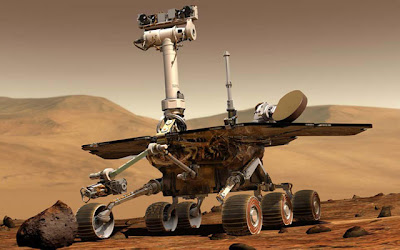
The Mars Rovers are the robots that were sent to Mars when today's juniors and seniors in high school were still in middle school. They had a three month mission. They've been at it about five years. In fact, just a month ago the rover Spirit celebrated its 2000th "sol", or Martian day. It's been experiencing some rough weather recently- dust storms.
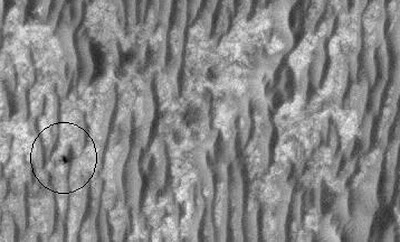
Thr rover Opportunity, on the other hand, has been plodding away. In fact, in the photo below, you can see a photo of Opportunity taken by an orbiting satellite. If you look carefully, you can even see the wheel tracks it has left behind. Opportunity has travelled over 100 meters in a day. It is headed toward an interesting crater named Endeavor. At this rate, it will be thee in about two Earth years.

Credit: NASA/JPL/University of Arizona

Wednesday, September 9, 2009

New lease on life for Hubble


If you are a regular follower of this blog, then you know that last October it carried a story about the Hubble Space telescope upgrade being cancelled. (See http://sms-astro-08.blogspot.com/2008/10/hubble-time-to-say-goodbye.html)
Then of course the astronomy class is not offered again in the spring, so the blog hibernates. Well, last spring the Hubble was in fact rejuvenated- last May, shuttle astronauts did a series of repairs and upgrades and two new instruments were added. The official NASA press release can be found here.
It took three months of calibrations to get the telescope back on line, but today NASA released some of the images taken by the refurbished Hubble. Plans are to observe "Kuiper Belt objects at the fringe of our solar system; survey the birth of planets around other stars; and probe the composition and structure of extrasolar planet atmospheres; take the deepest-ever near-infrared portrait of the universe to reveal never-before-seen infant galaxies that existed when the universe was less than 500 million years old;and shed light on the behavior of dark energy, a repulsive force that is pushing the universe apart at an ever-faster rate."
The picture at the top of this blog gives some idea of the amount of detail the images contain; the image below is of colored stars in a cluster actually zoomable on the Hubble site itself.


Wednesday, September 2, 2009

Beautiful Astronomy


In class we were discussing telescopes, and how they can show us things our eyes can't see because they collect more light by having bigger "pupils" (apertures.) Another way to collect more light is to spend more TIME collecting the light- this is what cameras do. Dr. Belknap, who is now in Jordan, alerted me to the first annual Astronomy Photographer of the Year contest, sponsored by England's Royal Observatory. Two British newspapers have posted some of the entries on their web sites- the Telegraph and the Guardian.
These are worth looking at- hard to pick a favorite, but the image above is quite nice. It is from the Telegraph site, and is described as


This colourful nebula, known as the Gabriela Mistral Nebula, contains a mass of giant, hot young stars. The bright colours are caused by different chemical elements found in the nebula as energy released from the stars excites the atoms and causes them to glow with different colours of light. It is named after the Chilean poet Gabriela Mistral as it is thought to bear a striking resemblance to her in profile.By Steve Crouch


Wednesday, August 26, 2009

The Myth of Mars


http://www.lcsd.gov.hk/CE/Museum/Space/StarShine/AstroEvent/MarsAtOpposition/e_starshine_ae_mao.htm
It seems that every summer since 2003 there is an exciting announcement that "Mars will be as large as the FULL MOON!" and "No living human has ever seen this before or will ever see it again!"
This summer the story says that Thursday, August 27 is that day- the first day of Astronomy class! How exciting! Unfortunately, it's just not true and everyone from Snopes to NASA can explain why.
So let me join in on debunking this story.
Planets orbit the sun not in circles but ellipses (off-centered ovals) and they orbit at different speeds. So as they orbit, the planets "pass" each other regularly, and they are both on the same side of the sun. And the distance between them varies, depending upon what part of the oval they are on. So while it is true that in 2003 (August 27, actually) the Earth and Mars were closer than they had been in 60,000 years, they weren't that much closer than they get every 15 years or so- and every two years they are "closer than usual". This is called perihelic opposition, and the closest the two planets can get to each other is 35 million miles, but it might be as much as around 60 million miles.

So while Mars can get within about 35 million miles of the earth every couple of decades, and it can get quite bright, it will never look as large as a full moon. It's just too far away.

Tuesday, August 25, 2009

First Homework Assignment!

Homework 8-27-08 DUE BY MONDAY AUGUST 31 2009
Read the introduction to your textbook, pages 2-11.
Choose ONE of the following questions and answer it thoroughly. This is your first homework, and with it you are making a first impression upon your teacher. Use your best written English to answer the question. Demonstrate your ability to communicate. Your grade will be based on your quality of expression; there is no “right” or “wrong” answer. Show me the best writing of which you are capable.YOUR RESPONSE SHOULD BE ADDED AS A COMMENT TO THIS BLOG.
1. It has been suggested that the universe may be 15 billion years old. The introduction of your textbook defines a light year as the distance traveled by light on one year. Light travels at about 3 x 10^5 kilometers (km) per second. Explain how this information could be used to predict that the universe must be smaller than 2 x 10^26 km across.
2. The Bible states in Joshua 10:12-13 that “…the sun stood still and the moon stopped, till the nation avenged itself on its enemies, as it is written in the book of Jashar. The sun stopped in the middle of the sky and delayed going down about a full day.” (Scripture taken from the Holy Bible, New International Version, 1984, International Bible Society, Colorado Springs, CO. Used by permission.) Is there any conflict between believing the biblical account of the sun stopping in the sky and the structure of our solar system as described in the introduction of your textbook?
3. One reason that many people are interested in astronomy is the possibility that life exists beyond the earth. With particular reference to the description of the scientific method, what sort of evidence (not including actually meeting an alien!) do you feel would be required to make a strong claim that life probably exists elsewhere?