Wednesday, August 26, 2009

The Myth of Mars


http://www.lcsd.gov.hk/CE/Museum/Space/StarShine/AstroEvent/MarsAtOpposition/e_starshine_ae_mao.htm
It seems that every summer since 2003 there is an exciting announcement that "Mars will be as large as the FULL MOON!" and "No living human has ever seen this before or will ever see it again!"
This summer the story says that Thursday, August 27 is that day- the first day of Astronomy class! How exciting! Unfortunately, it's just not true and everyone from Snopes to NASA can explain why.
So let me join in on debunking this story.
Planets orbit the sun not in circles but ellipses (off-centered ovals) and they orbit at different speeds. So as they orbit, the planets "pass" each other regularly, and they are both on the same side of the sun. And the distance between them varies, depending upon what part of the oval they are on. So while it is true that in 2003 (August 27, actually) the Earth and Mars were closer than they had been in 60,000 years, they weren't that much closer than they get every 15 years or so- and every two years they are "closer than usual". This is called perihelic opposition, and the closest the two planets can get to each other is 35 million miles, but it might be as much as around 60 million miles.
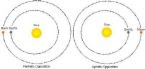
So while Mars can get within about 35 million miles of the earth every couple of decades, and it can get quite bright, it will never look as large as a full moon. It's just too far away.

Tuesday, August 25, 2009

First Homework Assignment!

Homework 8-27-08 DUE BY MONDAY AUGUST 31 2009
Read the introduction to your textbook, pages 2-11.
Choose ONE of the following questions and answer it thoroughly. This is your first homework, and with it you are making a first impression upon your teacher. Use your best written English to answer the question. Demonstrate your ability to communicate. Your grade will be based on your quality of expression; there is no “right” or “wrong” answer. Show me the best writing of which you are capable.YOUR RESPONSE SHOULD BE ADDED AS A COMMENT TO THIS BLOG.
1. It has been suggested that the universe may be 15 billion years old. The introduction of your textbook defines a light year as the distance traveled by light on one year. Light travels at about 3 x 10^5 kilometers (km) per second. Explain how this information could be used to predict that the universe must be smaller than 2 x 10^26 km across.
2. The Bible states in Joshua 10:12-13 that “…the sun stood still and the moon stopped, till the nation avenged itself on its enemies, as it is written in the book of Jashar. The sun stopped in the middle of the sky and delayed going down about a full day.” (Scripture taken from the Holy Bible, New International Version, 1984, International Bible Society, Colorado Springs, CO. Used by permission.) Is there any conflict between believing the biblical account of the sun stopping in the sky and the structure of our solar system as described in the introduction of your textbook?
3. One reason that many people are interested in astronomy is the possibility that life exists beyond the earth. With particular reference to the description of the scientific method, what sort of evidence (not including actually meeting an alien!) do you feel would be required to make a strong claim that life probably exists elsewhere?

Tuesday, December 9, 2008

Life in the Universe

There is definitely life in the universe.  It is us!  Is there other life in the universe, though? And if so, are "they" like "us"?  The Drake Equation allows us to consider some of the variables that would influence the development of advanced, technological, intelligent life around the galaxy.  Some others, including Dr. Michio Kaku of City University of New York, have speculated about the nature of advanced life based on the idea that the laws of physics are universal, and they place limits on the development of life. Some of his speculation focuses on the need for advanced civilizations to harness vast amounts of energy just to avoid being wiped out by natural disasters. And of course the biggest natural disaster of them all is the end of the universe- current theories suggest that the universe has an open structure, which means that the ultimate fate of the universe is ever accelerating expansion and cooling, a "Big Chill". If civilizations become advanced enough, they  may be more interested in escaping this universe by manipulating space and time itself rather than contacting their neighbors...
But enough about physics.  From what we k now about the evolution of advanced civilization on earth, which of the following statements would you think is most likely to be as universal as gravity itself?  Write your answer as a blog comment below, before the end of the day December 19 2008.
·         Life will inevitably emerge when conditions are suitable

·         When life emerges, it will lead to advanced intelligent civilizations

·         When life emerges, it will be based on cells

·         When life emerges, it will be subject to natural selection

For more information about Dr. Kaku visit http://www.astrobio.net/news/modules.php?op=modload&name=News&file=article&sid=939&mode=thread&order=0&thold=0 

Friday, November 21, 2008

The International Space Station- the tenth anniversary numbers


Nov. 20, 2008- today
Nov. 20, 1998- Russians launch the first component of the International Space Station from their space center in Kazakhstan.
16- number of nations supporting the space station (including NASA, the Russian Federal Space Agency, Canadian Space Agency, Japan Aerospace Exploration Agency, or JAXA, and 11 members of the European Space Agency, or ESA: Belgium, Denmark, France, Germany, Italy, the Netherlands, Norway, Spain, Sweden, Switzerland and the United Kingdom.)
14- number of countries that have sent crews to the space station
167- number of individuals who have crewed the station
19,000 – number of meals they have eaten in space
30- number of flights to the station by American and Russian spacecraft
114- number of spacewalks involved in the construction of the station
1 - The length of the space station in football fields
6- area of the solar energy panels in basketball courts
240- number of miles above the Earth the space station orbits
57,309- number of orbits the station made in ten years
1,432,725,000- number of miles the station has travelled (That’s about a billion and a half miles- about the distance to Uranus!)
100,000- number of people on earth involved in support for the space station
http://www.nasa.gov/mission_pages/station/main/10th_main.html

Monday, November 17, 2008

Phoenix Obituary


The Mars lander Phoenix has apparently stopped functioning after five months of data collection. It was the northernmost landing area of any spacecraft sent to Mars. "Apparently", because the mission engineers will continue to monitor for signals sent by Phoenix, but it is likely that the recent dust storms on Mars have not allowed enough sunlight to reach its solar panels to allow the equipment to continue operation. The lander was originally intended to function for three months. The last signal was received November 2, 2008.

It was a very sophisticated remote laboratory, and among its accomplishments were confirming the presence of water-ice below the surface of Mars (it had an arm for digging into the soil), taking over 25 000 photos using the first "atomic force microscope" ever used outside the Earth, doingn chemical analysis of the martian soil, and studying martian weather, including the first ever observation of snow falling from the clouds on Mars! (See this blog September 29). All things Phoenix can be found at http://www.nasa.gov/phoenix .


Monday, October 20, 2008

Accelerating Returns

In August, Richard Dell and Alan Rich from the Google Lunar X-Prize team STELLAR came to our school to talk about their proposal for lunar exploration. In the course of the discussion, some students questioned whether or not the progress Mr. Dell and Mr. Rich were talking about could possibly occur so quickly. Mr. Dell argued that we can expect that rate of progress, and referred to Kurzweil’s law. It might be worth looking into what that “Law” really is.
In a nutshell, it proposes exponential growth in technological progress. But a nutshell doesn’t really do it justice, so we must step back a bit first. Have you heard of Moore’s Law? This states that the capabilities of digital electronic devices will increase exponentially, doubling every two years. Capabilities include such factors as computer processing speed, but also things that are found in consumer electronics such as memory storage capacity, or pixels in a digital camera. Moore’s law was formulated and stated in a paper by Intel co-founder in 1965. It has pretty much been true for electronic hardware. (an argument has been made that software complexity slows things down faster than hardware speeds things up, but that’s another blog entry…)
Ray Kurzweil takes this idea one step farther, and extrapolates to before the invention of the integrated circuit, and beyond to technologies that haven’t yet been invented. He argues that the rate of change is accelerating; that the technological progress during the 20th century (think: Henry Ford and the Wright brothers to Bill Gates and the Space Shuttle) will be exceeded by a factor of a THOUSAND in the 21st century. It even suggests a “technological singularity”, technological progress hastened beyond anything ever seen as a result of machines smarter than humans learning to improve their own designs…
This is not to say that everyone accepts Kurzweil’s Law, there are plenty of criticisms and you can find them in some of the web sites referenced below. Thanks to Richard Dell for helping with the research for this posting.
http://en.wikipedia.org/wiki/Technological_Singularity
http://en.wikipedia.org/wiki/Moore%27s_Law
http://en.wikipedia.org/wiki/Raymond_Kurzweil#The_Law_of_Accelerating_Returns
http://en.wikipedia.org/wiki/Accelerating_change
http://www.kurzweilai.net/meme/frame.html?main=/articles/art0610.html?m%3D1

Thursday, October 16, 2008

No Sunspots- a 50 year low!

In class we discussed sunspot and other solar activities. I set up the refractor telescope after class in order to image the sun so that you could see some sunspots; but there appeared to be nothing there!  Nothing.  I thought that was very strange, so I did some research.  Guess what?  Just this month NASA's Marshall Space Flight Center announced that we are in the midst of a deep minimum of the solar cycle the likes of which have not been seen since BEFORE the launch of Sputnik (see earlier blogs), even before Mr. Mueller was born!  You have to go back to 1954 to find a year with a quieter sun. If the trend continues, it could end up being the quietest year for solar activity in a century.  Having said that, they believe that the 20th century was a particularly active time for solar activity, and that this may be more of a normal level of sunspot activity.  It turns out that solar wind is also at its lowest level in 50 years.  Coincidence?
  
On the right is the sun on September 27 2001; on the left Sept 27 2008.  Notice the total lack of sunspots. (Credit: ESA/NASA Solar and Heliospheric Observatory (SOHO))

Sources: 
Phillips, Dr Tony. "Spotless Sun: Blankest Year Of The Space Age." UPI Space Daily. 03 Oct 2008. n/a. eLibrary Science. Proquest. UMI - INTERNAL ELIBRARY SCIENCE TRIAL ACCOUNT. 16 Oct 2008. .
http://www.sciencedaily.com/releases/2008/10/081006184638.htm